> For the complete documentation index, see [llms.txt](https://docs.heeler.com/mrecEO40m5D6bt7Pq5pE/llms.txt). Markdown versions of documentation pages are available by appending `.md` to page URLs; this page is available as [Markdown](https://docs.heeler.com/mrecEO40m5D6bt7Pq5pE/catalog/data-inventory/categories.md).
# Categories
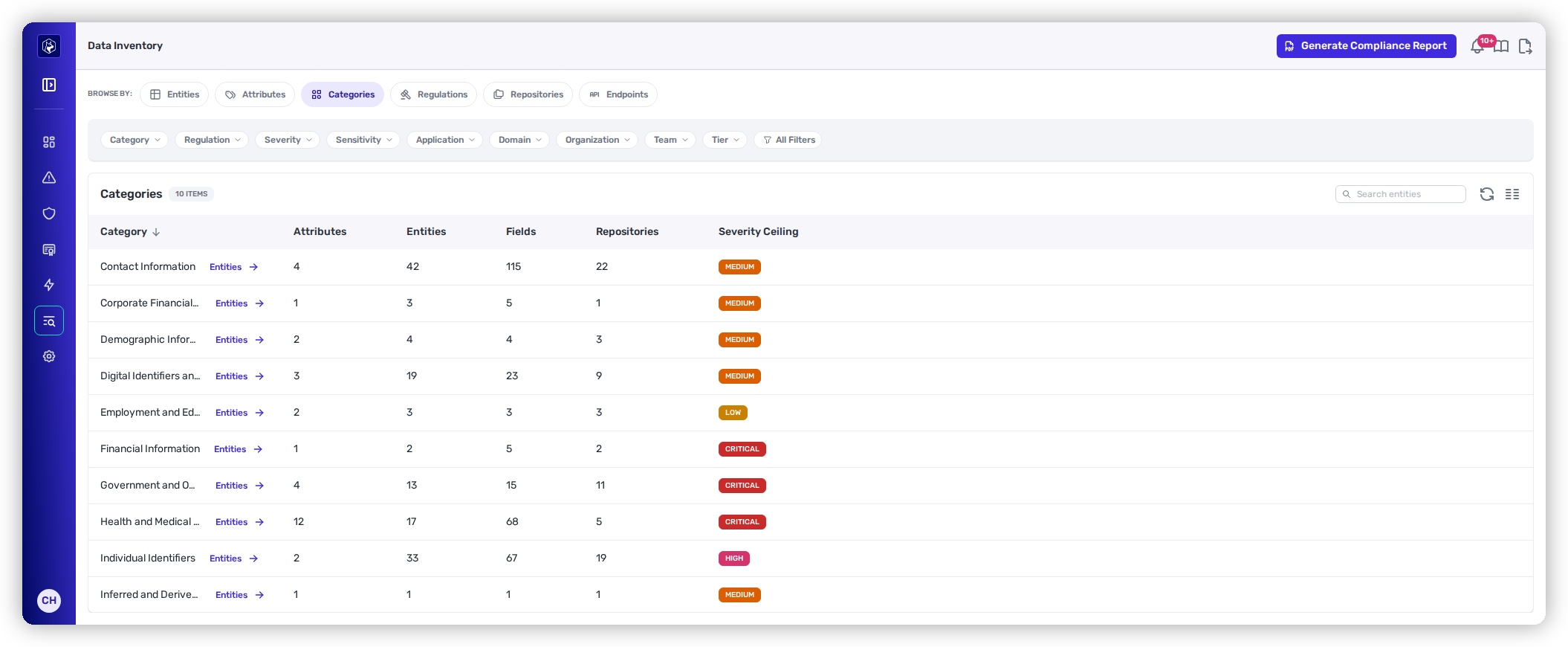
Data categories found in your code, each with the attributes beneath it, how widely it appears, and the highest severity it can reach.
A **category** groups related attributes — Contact Information gathers email addresses, phone numbers, and postal addresses; Digital Identifiers and Credentials gathers usernames and user IDs. Categories are the level most reporting happens at, because they're coarse enough to talk about and specific enough to act on.
Categories — the grouping most reporting happens at.
## Columns
| Column | What it shows |
| -------------------- | ------------------------------------------------------------------------------------------------------ |
| **Category** | The category name. Select it to drill into the entities carrying it. |
| **Attributes** | How many distinct attributes in this category were found in your code. |
| **Entities** | How many entities carry at least one attribute from it. |
| **Fields** | How many individual fields were classified into it. |
| **Repositories** | How many repositories contain it. |
| **Severity Ceiling** | The highest severity of any attribute found in this category — the worst case the category represents. |
## Severity ceiling
The ceiling is deliberately the maximum rather than an average. A category holding nine Low attributes and one Critical one is a Critical problem, and averaging would hide that. When you need the distribution instead, drill in or use [Attributes](/mrecEO40m5D6bt7Pq5pE/catalog/data-inventory/attributes.md), where each attribute carries its own severity.
## Drilling in
Selecting a category filters the inventory to it, and the filter is carried between views: from a category to the entities that hold it, then to the repositories that own those entities.
## Related
* [Attributes](/mrecEO40m5D6bt7Pq5pE/catalog/data-inventory/attributes.md) — the individual attributes inside each category.
* [Entities](/mrecEO40m5D6bt7Pq5pE/catalog/data-inventory/entities.md) — where the categories were found.
* [Data Inventory](/mrecEO40m5D6bt7Pq5pE/catalog/data-inventory.md) — how classification assigns a category.
---
# Agent Instructions
This documentation is published with GitBook. GitBook is the documentation platform designed so that both humans and AI agents can read, navigate, and reason over technical content effectively. Learn more at gitbook.com.
## Querying This Documentation
If you need additional information that is not directly available in this page, you can query the documentation dynamically by asking a question.
Perform an HTTP GET request on the current page URL with the `ask` query parameter, and the optional `goal` query parameter:
```
GET https://docs.heeler.com/mrecEO40m5D6bt7Pq5pE/catalog/data-inventory/categories.md?ask=&goal=
```
`ask` is the immediate question: it should be specific, self-contained, and written in natural language.
`goal` is optional and describes the broader end goal you are ultimately trying to accomplish on behalf of the user. GitBook uses it to tailor the answer towards what is most useful for that goal.
The response will contain a direct answer to the question and relevant excerpts and sources from the documentation.
Use this mechanism when the answer is not explicitly present in the current page, you need clarification or additional context, or you want to retrieve related documentation sections.