> For the complete documentation index, see [llms.txt](https://docs.heeler.com/mrecEO40m5D6bt7Pq5pE/llms.txt). Markdown versions of documentation pages are available by appending `.md` to page URLs; this page is available as [Markdown](https://docs.heeler.com/mrecEO40m5D6bt7Pq5pE/catalog/data-inventory/regulations.md).
# Regulations
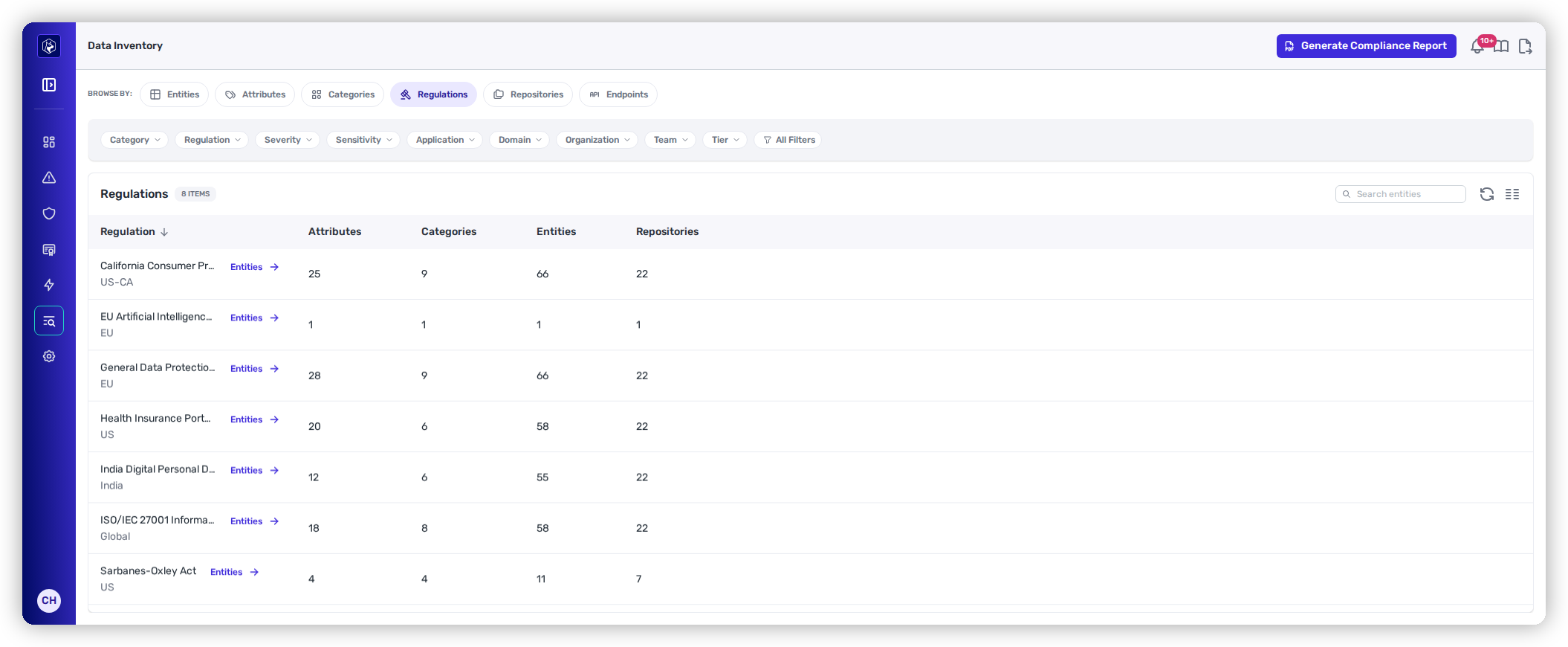
The regulations that apply to the data your code handles, each with the attributes, categories, entities, and repositories that bring it into scope.
This view turns the inventory around: instead of starting from your data and asking what it is, it starts from a regulation and shows what in your code falls under it.
Each row is a regulation Heeler's taxonomy maps attributes to, with its jurisdiction beneath the name — for example the **General Data Protection Regulation** (EU), the **California Consumer Privacy Act** (US-CA), the **Health Insurance Portability and Accountability Act** (US), **India's Digital Personal Data Protection Act** (India), **ISO/IEC 27001** (Global), **US State Privacy Laws** (US), and the **Sarbanes-Oxley Act** (US).
Not every regulation here is a privacy regulation. **Sarbanes-Oxley** is about financial-reporting integrity, and it maps where a data class records or feeds your own financial transactions — payments, banking, payroll, tax — rather than anything about a person. That distinction matters when you scope: filtering to SOX gives you the financial-data footprint, not a subset of your PII.
Regulations — what in your code falls under each set of rules, Sarbanes-Oxley included.
## Columns
| Column | What it shows |
| ---------------- | ------------------------------------------------------------------------------------------------- |
| **Regulation** | The regulation, with its jurisdiction underneath. Select it to filter the inventory to its scope. |
| **Attributes** | How many distinct attributes in your code this regulation treats as in scope. |
| **Categories** | How many data categories those attributes span. |
| **Entities** | How many discovered entities hold in-scope data. |
| **Repositories** | How many repositories those entities live in. |
{% hint style="info" %}
**Counts overlap between rows, by design.** One attribute is commonly in scope for several regulations at once — an email address is in scope for GDPR and for US state privacy laws — so the same entity legitimately appears under more than one regulation. The numbers are not meant to sum.
{% endhint %}
## Answering a scope question
The usual task is "which of our repositories bring *this* regulation into scope?" Select the regulation, then switch to [Repositories](/mrecEO40m5D6bt7Pq5pE/catalog/data-inventory/repositories.md): the filter carries across, and the list is your answer with owning teams attached.
For the attribute-level reason a regulation applies, go to [Attributes](/mrecEO40m5D6bt7Pq5pE/catalog/data-inventory/attributes.md) with the same filter — the **Regulations** column there shows exactly which kinds of data pulled it in.
## Reporting
**Compliance Report** produces a point-in-time document for the regulations in the current scope, when the answer needs to leave the product — see [Compliance Reports](/mrecEO40m5D6bt7Pq5pE/standards-and-compliance/compliance-reports.md).
A report scoped to a single regulation carries that regulation's own description in its header, and its section wording follows the **sensitivity** in scope — so a Sarbanes-Oxley report reads as a financial-data report rather than borrowing the personal-data language a privacy scope needs.
{% hint style="warning" %}
**This is an inventory, not a legal determination.** Heeler reports which data in your code its taxonomy maps to a regulation. Whether your organization is in compliance depends on controls, contracts, and processing purposes that live outside the code.
{% endhint %}
## Related
* [Repositories](/mrecEO40m5D6bt7Pq5pE/catalog/data-inventory/repositories.md) — the repositories behind a regulation's scope.
* [Attributes](/mrecEO40m5D6bt7Pq5pE/catalog/data-inventory/attributes.md) — the attribute-level mapping that pulls a regulation in.
* [Data Inventory](/mrecEO40m5D6bt7Pq5pE/catalog/data-inventory.md) — how classification assigns regulations.
---
# Agent Instructions
This documentation is published with GitBook. GitBook is the documentation platform designed so that both humans and AI agents can read, navigate, and reason over technical content effectively. Learn more at gitbook.com.
## Querying This Documentation
If you need additional information that is not directly available in this page, you can query the documentation dynamically by asking a question.
Perform an HTTP GET request on the current page URL with the `ask` query parameter, and the optional `goal` query parameter:
```
GET https://docs.heeler.com/mrecEO40m5D6bt7Pq5pE/catalog/data-inventory/regulations.md?ask=&goal=
```
`ask` is the immediate question: it should be specific, self-contained, and written in natural language.
`goal` is optional and describes the broader end goal you are ultimately trying to accomplish on behalf of the user. GitBook uses it to tailor the answer towards what is most useful for that goal.
The response will contain a direct answer to the question and relevant excerpts and sources from the documentation.
Use this mechanism when the answer is not explicitly present in the current page, you need clarification or additional context, or you want to retrieve related documentation sections.