> For the complete documentation index, see [llms.txt](https://docs.heeler.com/mrecEO40m5D6bt7Pq5pE/llms.txt). Markdown versions of documentation pages are available by appending `.md` to page URLs; this page is available as [Markdown](https://docs.heeler.com/mrecEO40m5D6bt7Pq5pE/get-started/registries-and-artifacts/gitlab-package-registry.md).
# GitLab Package Registry
Connect the GitLab Package Registry so Heeler treats the libraries your teams publish there as first-party code, reusing your GitLab connection.
Heeler connects to the **GitLab Package Registry** to analyze the package artifacts your teams publish — treating them as first-party code. It reuses the credential from your existing [GitLab code connection](/mrecEO40m5D6bt7Pq5pE/get-started/source-code-scm/gitlab.md), so there's no separate token to create.
{% hint style="info" %}
On the **Add Registry** menu, this provider is listed as **GitLab**.
{% endhint %}
## Before you start
* A [**GitLab code connection in Heeler**](/mrecEO40m5D6bt7Pq5pE/get-started/source-code-scm/gitlab.md). The registry reuses that group access token (its `api` / `read_package_registry` scope also covers reading the package registry).
## Add the GitLab Package Registry
{% stepper %}
{% step %}
### Open the modal
Go to **Connections → Registries → Add Registry → GitLab**.
{% endstep %}
{% step %}
### Configure it
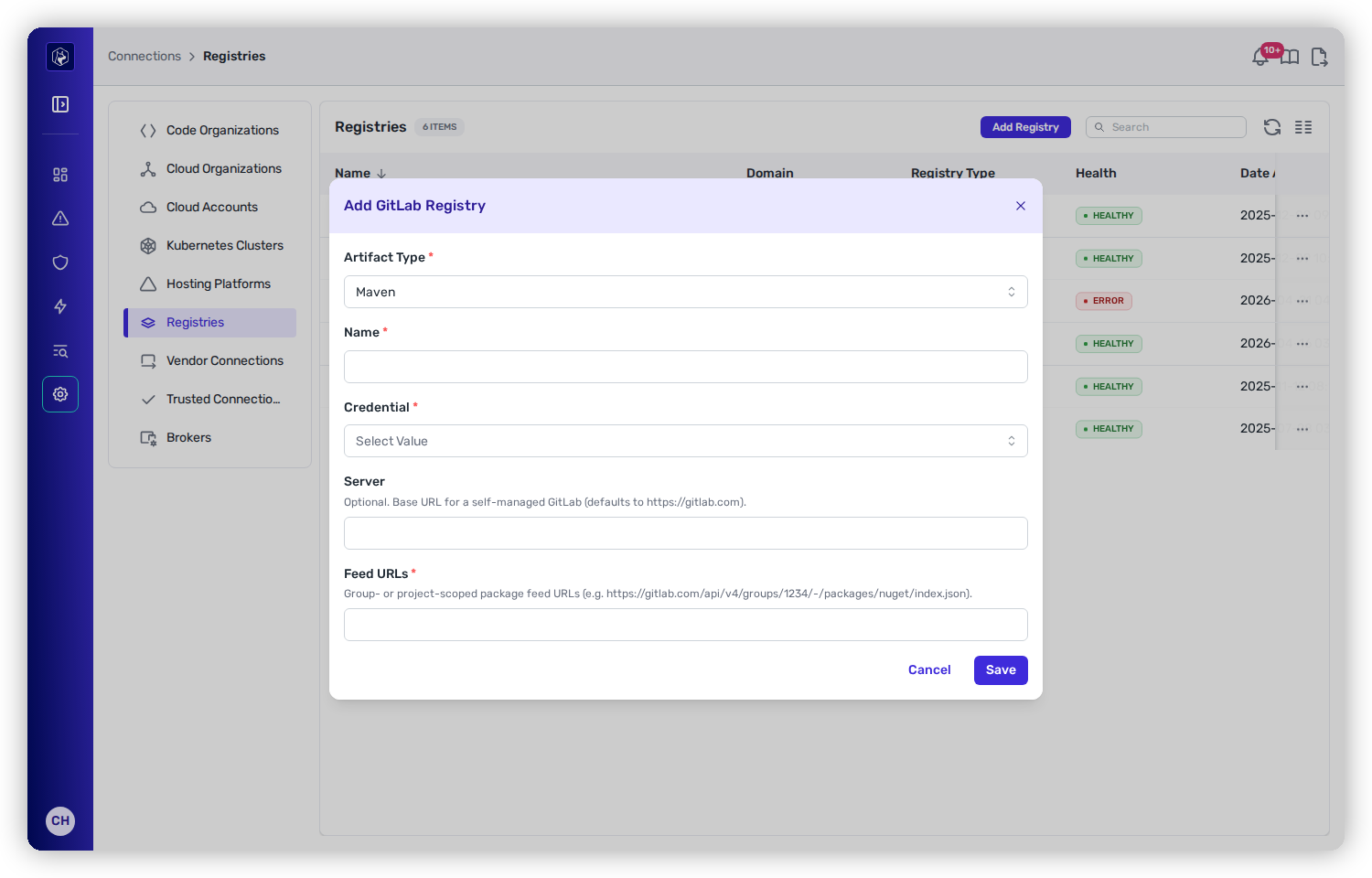
* **Artifact Type** — the package ecosystem to analyze (Maven, NPM, NuGet, or PyPI). Create one connection per ecosystem.
* **Name** — a label for the connection.
* **Credential** — the existing GitLab credential Heeler already uses (the dropdown lists your configured GitLab connections).
* **Server** — optional; defaults to `https://gitlab.com`. Enter your instance URL for self-managed GitLab.
* **Feed URLs** — the package feed URLs Heeler should collect from.
The GitLab Package Registry reuses your existing GitLab credential.
{% endstep %}
{% step %}
### Save and verify
Click **Save**, then confirm the connection is **Healthy** under **Connections → Registries**.
{% endstep %}
{% endstepper %}
## Related
* [Connect Your Code → GitLab](/mrecEO40m5D6bt7Pq5pE/get-started/source-code-scm/gitlab.md) — the connection this reuses.
* [Connect Registries and Artifacts](/mrecEO40m5D6bt7Pq5pE/get-started/registries-and-artifacts.md) — the common flow.
---
# Agent Instructions
This documentation is published with GitBook. GitBook is the documentation platform designed so that both humans and AI agents can read, navigate, and reason over technical content effectively. Learn more at gitbook.com.
## Querying This Documentation
If you need additional information that is not directly available in this page, you can query the documentation dynamically by asking a question.
Perform an HTTP GET request on the current page URL with the `ask` query parameter, and the optional `goal` query parameter:
```
GET https://docs.heeler.com/mrecEO40m5D6bt7Pq5pE/get-started/registries-and-artifacts/gitlab-package-registry.md?ask=&goal=
```
`ask` is the immediate question: it should be specific, self-contained, and written in natural language.
`goal` is optional and describes the broader end goal you are ultimately trying to accomplish on behalf of the user. GitBook uses it to tailor the answer towards what is most useful for that goal.
The response will contain a direct answer to the question and relevant excerpts and sources from the documentation.
Use this mechanism when the answer is not explicitly present in the current page, you need clarification or additional context, or you want to retrieve related documentation sections.